KLOW vs GLOW Peptide Blends: What’s the Difference?
Ask five researchers what separates the KLOW and GLOW peptide blends and you’ll get five slightly different answers. That’s a

For the wider context, see our overview of research peptides for weight loss.
It’s the same idea with one extra lever, since retatrutide and tirzepatide are both once-a-week injectable peptides for weight loss, but retatrutide works three gut-hormone receptors where tirzepatide works two. And in the trials, that shows up: retatrutide landed around 24 percent body-weight loss, tirzepatide around 21 percent. So the third receptor seems to buy a little more.[1]
This article is for research and educational use only. Retatrutide is an experimental research compound and tirzepatide is a prescription drug. Nothing here is medical advice.
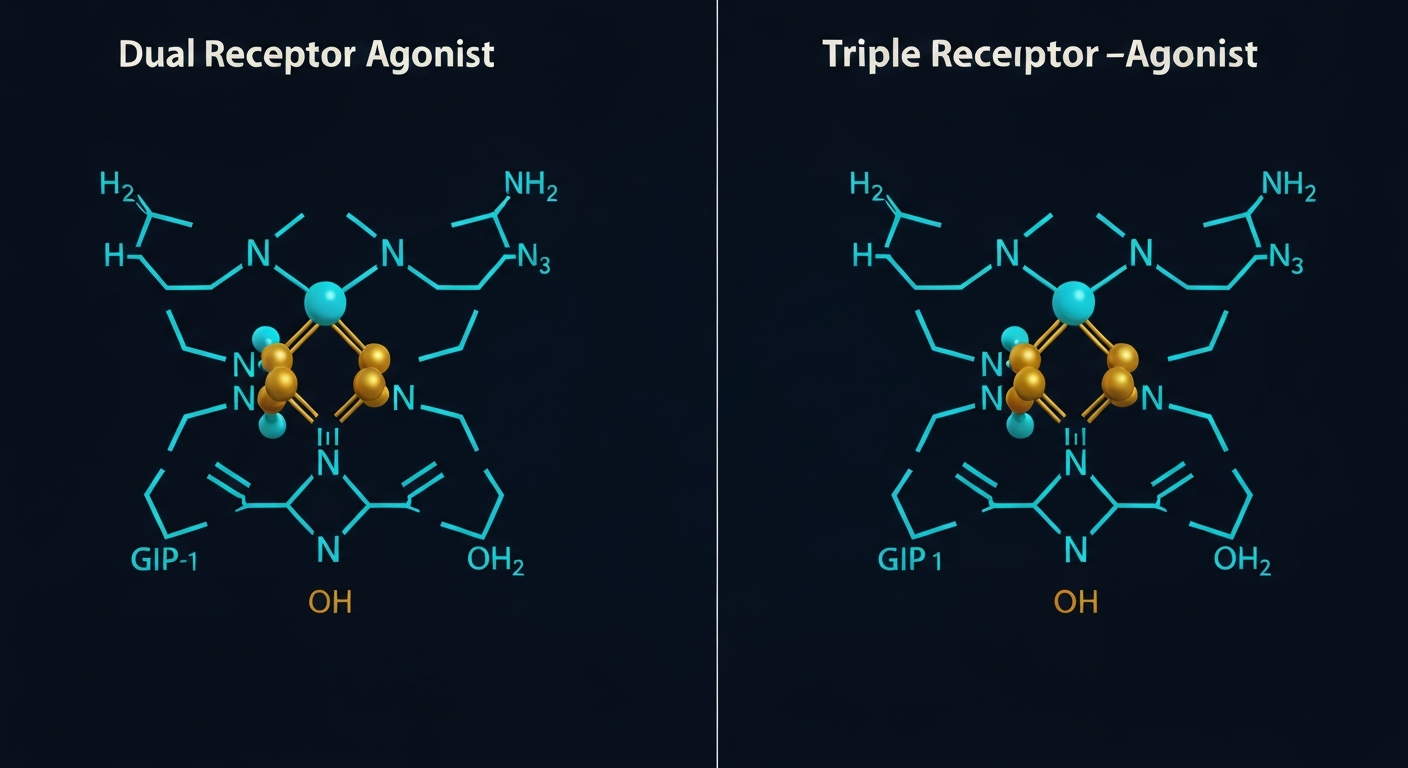
That third receptor is glucagon, and it changes the game a bit. Tirzepatide switches on GLP-1 (kills appetite, slows the stomach) and GIP (bumps insulin and helps shift fat). Retatrutide adds glucagon on top, which cranks up energy burning through brown fat and a higher metabolic rate. Now, glucagon on its own would push blood sugar up, which sounds like a problem. But retatrutide is tuned so the GLP-1 and GIP parts keep blood sugar in check while the glucagon part just adds the extra burn. The Phase 2 numbers lean retatrutide’s way, though there’s a catch: no direct head-to-head trial exists yet, so it isn’t a perfectly clean apples-to-apples comparison.
Stick around and I’ll walk through how the two differ at the receptor level, what the clinical-trial data show on weight, blood sugar, and side effects, how they stack up on cholesterol and liver fat, and what that missing head-to-head really means. Every claim links to a primary source.
Both are once-a-week peptides that switch on gut-hormone receptors all over the body. The difference is just the count: tirzepatide hits two, retatrutide hits three.
Take tirzepatide first, where Willard’s pharmacology work in JCI Insight shows the molecule, LY3298176, turning on both the GIP and GLP-1 receptors.[2] GLP-1 does the appetite-and-stomach part; GIP handles the insulin boost and some central appetite effects.
Retatrutide takes it one step further, and Kaur’s review in the European Journal of Clinical Pharmacology lays out how the triple peptide adds the glucagon receptor on top of GLP-1 and GIP.[3] And in the Phase 2 obesity trial, reported by Jastreboff’s group, retatrutide, or LY3437943, fired all three receptors with a balanced fit, so nothing gets left behind.[1] That extra glucagon receptor is the energy-burning piece the two-receptor drug simply doesn’t have.
On the data so far, yes, retatrutide takes off more at the top doses studied. Here’s the shape of it. Retatrutide at 12 mg over 48 weeks came in around 24.2 percent average weight loss. Tirzepatide at 15 mg over 72 weeks landed at 20.9 percent. And for reference, semaglutide at 2.4 mg over 68 weeks sits at 14.9 percent, so the ladder is real even if the rungs come from different studies.
Those tirzepatide numbers come from SURMOUNT-1, where Jastreboff’s team logged large, durable weight loss over 72 weeks in adults with obesity.[4] On the other side, Rosenstock and colleagues, in the Lancet, showed retatrutide delivering strong glycemic control and big weight loss in people with type 2 diabetes, beating tirzepatide at similar doses in the efficacy comparison.[5] One honest caveat, though: there’s no direct head-to-head Phase 3 trial yet, so all of this is stitched together from separate trials.
Boil it down and a few differences actually matter. Receptors are the big one: tirzepatide runs GLP-1 plus GIP, retatrutide runs GLP-1 plus GIP plus glucagon. That changes how the weight comes off, too, because tirzepatide leans on appetite and insulin while retatrutide adds outright energy burning. Approval status is night and day: tirzepatide is FDA-approved (Mounjaro in 2022, Zepbound in 2023), while retatrutide is still working through Phase 3. On the scale, top doses run about 20.9 percent for tirzepatide versus 24.2 percent for retatrutide, and retatrutide hit its number in a shorter window at that. Dosing looks nearly identical, both once-a-week shots on similar step-up schedules. And the side-effect profile is the same stomach-heavy pattern, with retatrutide sitting slightly higher at the top doses.
They share the same gut-first adverse events this whole drug class is known for. Nausea leads the pack, hitting 30 to 50 percent at top doses for both. Vomiting shows up in the 10 to 20 percent range at the top. Then there’s diarrhea and constipation, injection-site reactions, and the appetite drop itself, which is the whole point but occasionally gets logged as a side effect. Heart rate ticks up a small, steady amount. And pancreatitis sits on the list as a rare, precautionary class warning.
Retatrutide’s rates run a bit hotter than tirzepatide at the top doses, roughly 6 to 16 percent stopping versus 4 to 10 percent, but it’s the same kinds of effects, not new ones. And the glucagon part doesn’t appear to push meaningful high blood sugar in people without diabetes, which was the obvious worry going in, so on the safety profile that’s the genuinely reassuring bit.
Both are a once-a-week shot under the skin, escalated slowly. Tirzepatide starts at 2.5 mg and climbs to 5, 7.5, 10, 12.5, and 15 mg across about 20 weeks. Retatrutide starts at 2 mg and steps up to 4, 8, and 12 mg over roughly 16 weeks, at least on the Phase 2 schedule, since Phase 3 may shuffle that. The slow climb is what keeps the stomach quiet; rush it and the side effects flare. Both can sit at a maintenance dose long-term, and stopping tends to let weight drift back toward the start over 6 to 12 months.
Appetite fades fast, within 1 to 3 days of the first dose. The energy-and-metabolism effects are quieter and build over weeks. Weight itself starts pulling away from placebo somewhere in the 4-to-8-week window of steady use. The nausea, meanwhile, peaks in the first week or two after each dose bump, then settles as the body adjusts. Tirzepatide follows basically the same arc.
In a research setting, and eventually the clinic, switching is doable. Both linger about 5 to 7 days in the body, so a one-week gap makes for a clean handoff. Expect the stomach side effects to come back after the switch, since the new drug works the receptors a little differently, so the smart move is to restart low and step up rather than match the old dose. Formal switching protocols aren’t tested in late trials yet, for the simple reason that retatrutide isn’t approved.
For obesity without diabetes, both do the job. Retatrutide’s bigger top-dose weight loss makes it the stronger option on paper. The theoretical worry, that the glucagon part might nudge blood sugar up in people without diabetes, hasn’t shown up as anything meaningful in Phase 2. But here’s the practical reality: if you want something you can actually get today, tirzepatide is the only one on the table. Retatrutide is still experimental.
It’s in the Phase 3 TRIUMPH program, which kicked off in 2022 with key results expected in 2026 to 2027. If the late data keeps tracking Phase 2, Health Canada and FDA approval looks plausible around 2027 or 2028. Until then, research-grade retatrutide is sold in Canada and the United States only as a research chemical for laboratory use.
Tirzepatide as Zepbound runs about CAD 600 to 700 a month at retail in Canada and the U.S. Insurance is a coin flip: some private plans cover obesity, public plans mostly don’t. Whenever retatrutide gets approved, its price will probably land near tirzepatide’s. Either way, neither is cheap enough for general obesity treatment without some insurance help.
If you plan to source either compound for research, it helps to know the legal framework for buying research peptides in Canada and how to vet a supplier.
Tirzepatide is FDA-approved in the U.S. and Health Canada-approved as Mounjaro for type 2 diabetes since 2024. Retatrutide isn’t approved anywhere yet. Research-grade material for both is legal in Canada and the United States as research chemicals sold for laboratory use only, and neither is on the World Anti-Doping Agency banned list.
Reviv Peptides supplies research-grade retatrutide and tirzepatide with third-party COA and HPLC purity confirmation. See the retatrutide 10mg vial or the tirzepatide 10mg vial for current specifications.
Confirm purity the moment each vial arrives, before you store or reconstitute it. Retatrutide and tirzepatide both ship as lyophilized (freeze-dried) powder, so check each one against its own batch-specific Certificate of Analysis (COA) from an independent lab: mass spectrometry should confirm the expected weight for that peptide and HPLC purity should read 98 percent or higher with the trace attached.[6] Because the two are close in size and use, keep their vials clearly labeled so you never mix up one batch’s COA with the other. Once a COA checks out, keep the sealed powder cold and dry. A verified lyophilized peptide stays stable that way, and you only mix it with bacteriostatic water right before use.[7]
On indirect comparison, yes. Retatrutide gave 24.2 percent weight loss at 12 mg over 48 weeks versus tirzepatide’s 20.9 percent at 15 mg over 72 weeks. There’s no head-to-head Phase 3 trial yet.
Tirzepatide is a two-receptor drug (GLP-1/GIP, FDA-approved); retatrutide is a three-receptor drug (GLP-1/GIP/glucagon, experimental). The added glucagon receptor brings energy burning. Both use once-a-week shots.
Top-dose weight loss: retatrutide 24.2 percent, tirzepatide 20.9 percent, semaglutide 14.9 percent. The amounts depend on dose, and the comparisons come from separate trials.
Both share stomach-heavy side effects: nausea, vomiting, diarrhea, constipation, injection-site reactions. Retatrutide’s rates are a bit higher at top doses. Rare pancreatitis is a precautionary class warning.
Not yet FDA or Health Canada-approved. Phase 3 TRIUMPH results are expected 2026 to 2027; approval is plausible 2027 to 2028.
Key data point: in SURMOUNT-1, tirzepatide’s dual GIP/GLP-1 action produced about 21 percent mean weight loss at 72 weeks. Retatrutide added roughly 2 to 3 percentage points through its glucagon receptor part, which targets liver-fat burning and heat-producing genes in brown fat, pathways that GLP-1 and GIP don’t directly turn on.
Think of retatrutide and tirzepatide as back-to-back generations of weight-loss peptides. Tirzepatide is the FDA-approved two-receptor drug (GLP-1/GIP) with about 20.9 percent average weight loss at top dose. Retatrutide is the experimental three-receptor drug (GLP-1, GIP, and glucagon) with about 24.2 percent in Phase 2. The whole difference is that glucagon receptor, which layers energy burning on top of the appetite-and-insulin effects of the older molecule. Both carry the class’s stomach-heavy side effects, with retatrutide running slightly higher at the top doses. Tirzepatide is the only approved option today; retatrutide is still in Phase 3. And research-grade material for both is legal in Canada and the United States for laboratory use only.
Sources: [1] Phase 2 obesity trial of retatrutide, PubMed. [2] Tirzepatide dual GIP/GLP-1 agonist pharmacology, PubMed. [3] Retatrutide triple agonist review, PubMed. [4] SURMOUNT-1 tirzepatide obesity trial, PubMed. [5] Retatrutide in type 2 diabetes, PubMed. [6] Reference standards for synthetic peptide quality (HPLC/MS purity), PMC. [7] Storage and handling of peptides, PMC.

The Reviv Peptides Research Team is a collective of science writers and researchers dedicated to producing evidence-based, peer-reviewed-grade content about research peptides. Our work focuses on molecular mechanisms, receptor pharmacology, and preclinical data — including GLP-1/GIP/glucagon incretin biology, growth hormone axis peptides (GHRH analogs and ghrelin-receptor secretagogues), mitochondrial-derived peptides (MOTS-c, SS-31), tissue-repair peptides (BPC-157, TB-500, GHK-Cu), and nootropic peptides (Semax, Selank). All content is written in a strict preclinical/laboratory context; none of our editorial material is intended as medical advice. Every guide is reviewed for scientific accuracy against published peer-reviewed literature.
Ask five researchers what separates the KLOW and GLOW peptide blends and you’ll get five slightly different answers. That’s a

A plain-language guide to the Canadian legal framework around peptides and the supplier criteria researchers should actually verify.
Discount Applied Successfully!
Your savings have been added to the cart.
Each tier you reach gives you more. Open one to see what it unlocks.
See what it takes to reach each tier.
Highest tier
Each tier you reach gives you more. Open one to see what it unlocks.
See what it takes to reach each tier.
Highest tier