
Best Peptides for Weight Loss in 2026: A Mechanistic Guide
A mechanistic ranking of weight-loss peptides studied in 2026: GLP-1s, GLP-1/GIP, triple agonists, AOD-9604, 5-Amino-1-MQ, and tesamorelin.

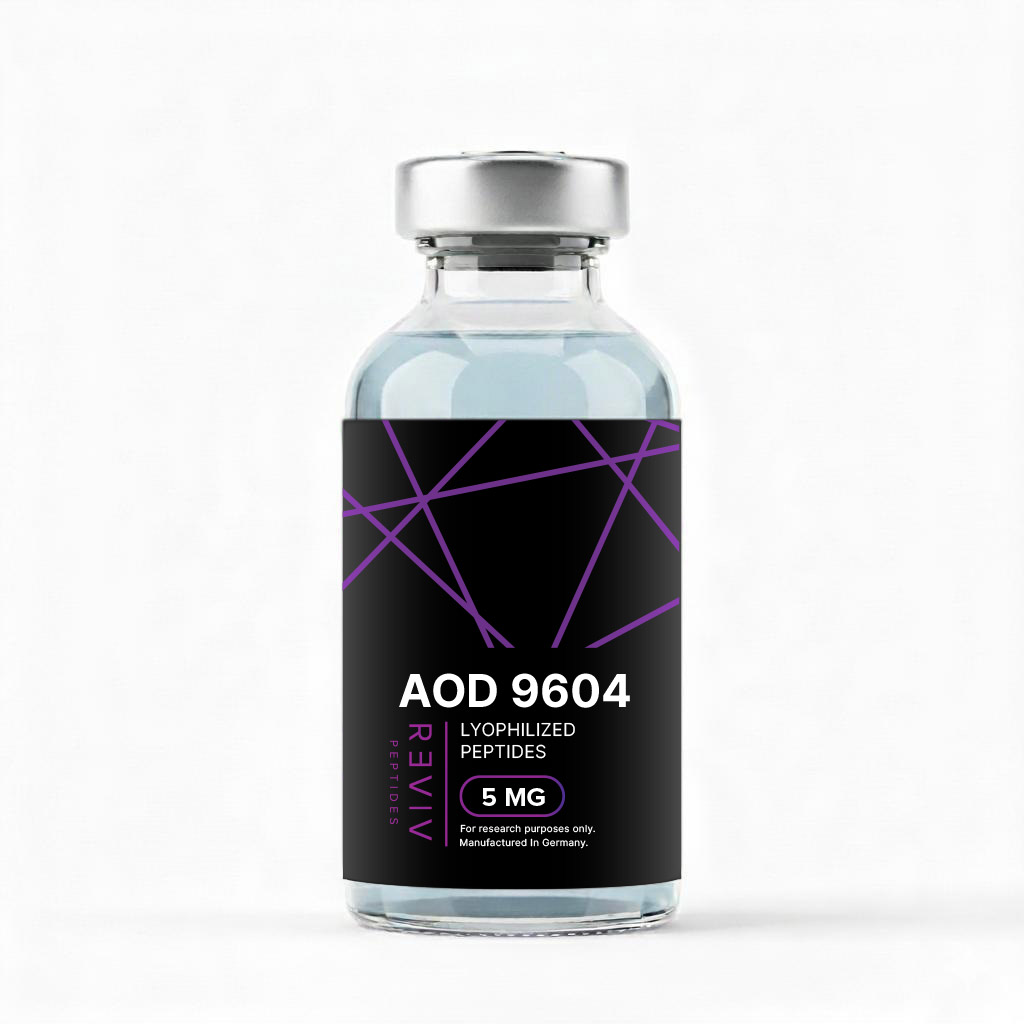
The central challenge with full-length growth hormone as an obesity treatment has always been the off-target effects: insulin resistance, IGF-1-driven proliferative risk, acromegalic changes with long-term use. AOD-9604 was designed specifically to avoid all of that. Identified at the Howard Florey Institute in Melbourne in the 1990s by researchers who were systematically mapping which region of the HGH molecule drove fat metabolism, the 16-amino-acid C-terminal fragment (residues 177-191) was found to stimulate lipolysis and inhibit lipogenesis in adipocytes without binding the full hGH receptor and without raising IGF-1. That's a pharmacologically clean separation — one that looked promising enough that Metabolic Pharmaceuticals pursued it through Phase 3 obesity trials.
The clinical history is instructive. AOD-9604 reached Phase 3 human trials for obesity but failed to demonstrate statistically significant weight loss in the broader population — a result that redirected the compound toward research applications rather than pharmaceutical approval. Worth noting: the rodent data was genuinely compelling. Studies in obese ob/ob mice and diet-induced obese models showed measurable reductions in body fat percentage, and the mechanism — engaging a beta-adrenergic-like pathway in adipocytes that's distinct from the full HGH receptor — has been reproduced in multiple cell-culture systems. The gap between robust rodent results and modest human outcomes is one of the more common patterns in metabolic peptide research, and AOD-9604 is a clean case study in why translational assumptions need to be tested rather than assumed.
This guide covers how AOD-9604 drives lipolysis without HGH receptor binding, what the preclinical and clinical literature shows on weight loss and metabolic effects, how it compares with other fat-loss peptide approaches, dosing and administration in research protocols, and what researchers should look for when sourcing material.
AOD-9604 is a synthetic version of the lipolytic domain of human growth hormone. According to the original PubMed-indexed pharmacology paper, A synthetic analogue (AOD9604) of the lipolytic domain of human growth hormone (residues 177-191) was designed to isolate the fat-specific effects of HGH from its broader growth-promoting actions. The peptide fragment contains a disulfide bond and a free N-terminal tyrosine that together produce the lipolytic-specific activity.
The receptor mechanism is distinctive. Published research shows that AOD9604 does not compete for the hGH receptor and nor does it induce cell proliferation, distinguishing it from full-length HGH and from IGF-1-based interventions. The peptide acts through a still-undefined receptor or through direct interaction with adipocyte cell-membrane components, driving lipolysis without the broad anabolic and mitogenic effects of GH.
The molecular mechanism of fat metabolism modulation runs through two enzymes. Published research shows that AOD9401 (a related analogue) stimulated hormone-sensitive lipase and inhibited acetyl coenzyme A carboxylase in cultured adipocytes. HSL activation drives triglyceride breakdown for energy use; ACC inhibition reduces the conversion of acetyl-CoA into malonyl-CoA, the rate-limiting step in fatty acid synthesis. The combination of upregulating fat breakdown and downregulating fat synthesis produces the lipolytic phenotype.
Published research shows that the parent compound AOD-9401 significantly reduced lipogenic activity and increased lipolytic activity in this tissue, with AOD-9604 inheriting the same dual mechanism in its refined form. Published research shows that the functional domain responsible for the antilipogenic activity of hGH resides in the C-terminal region of the parent hormone, validating the AOD-9604 design.
Effect sizes are modest. Phase 2 clinical trials in obese human subjects showed weight loss of approximately 2.6 kg over 12 weeks at the most effective dose (1 mg per day), compared with 0.8 kg in the placebo group. The clinical effect size is much smaller than GLP-1 agonists (semaglutide produces 14.9 percent weight loss over 68 weeks) or tirzepatide (20.9 percent over 72 weeks). The compound failed to demonstrate sufficient efficacy for FDA approval as a weight-loss therapy, which is part of why no AOD-9604 finished pharmaceutical exists.
Based on the available clinical data, expected weight loss over 12-24 weeks of treatment is in the 2-5 kg range, primarily from fat mass rather than lean mass. The body composition shift is favourable (fat-specific lipolysis with preserved lean mass) but the absolute weight reduction is small. For researchers studying lipolysis mechanism, the modest weight change is acceptable; for primary weight-loss endpoints, the GLP-1 class produces far larger effects.
The fat-loss peptide landscape covers several mechanism classes:
AOD-9604 occupies the smallest-effect niche but with the cleanest direct-adipocyte mechanism. It is a research tool for studying lipolysis biology, not a primary weight-loss therapy.
Published Phase 2 clinical trials used AOD-9604 at 1 mg per day by oral or subcutaneous administration. Research protocols span 300 μg to 1 mg per dose. The peptide is supplied as a lyophilised powder for reconstitution in bacteriostatic water. Oral bioavailability is documented (one of the few peptides with meaningful oral activity), though injectable routes provide more consistent pharmacokinetics in research contexts.
The safety profile is favourable. Reported adverse events in clinical and research use are minimal: occasional mild injection-site irritation, rare transient headache, and no documented hepatic, cardiac, or systemic safety signals. The peptide does not affect IGF-1 levels, glucose metabolism, or growth-related parameters, which avoids the GH-related adverse events of HGH itself. AOD-9604 was generally considered safe in the Phase 2 obesity trial program.
Relative contraindications are limited but include:
Patients seeking dramatic weight loss should not expect AOD-9604 to deliver the effect sizes of GLP-1 agonists. Researchers studying lipolysis pathways are the primary appropriate use case.
In clinical research, body weight curves separate from placebo within 4-6 weeks of consistent dosing, with effect size building through 12-24 weeks. Body composition changes (favouring fat mass loss) are visible on DEXA scans within 8-12 weeks. Subjective effects on energy and appetite are minimal; the mechanism is silent at the perception level.
AOD-9604 is not approved by Health Canada, the FDA, or the EMA as a finished pharmaceutical. The compound has Generally Recognised As Safe (GRAS) status in some food/dietary supplement contexts in the United States, but this status is unrelated to weight-loss medication regulation. The peptide is legal in Canada and the United States as a research chemical sold under research-use-only labelling. It is not on the World Anti-Doping Agency prohibited list.
Reproducible lipolysis research depends on the integrity of the input material:
Reviv Peptides supplies AOD-9604 with third-party COA and HPLC purity confirmation. View the AOD-9604 5mg product page.
Yes, with modest effect sizes. Phase 2 clinical data showed 2.6 kg weight loss over 12 weeks at 1 mg/day, primarily from fat mass rather than lean mass. Effect size is much smaller than GLP-1 agonists or other modern weight-loss peptides.
Expected weight loss is in the 2-5 kg range over 12-24 weeks of treatment, primarily from fat mass. Body composition shifts favourably but absolute weight reduction is small compared with GLP-1 agonists.
Pregnancy, breastfeeding, active malignancy, severe hypoglycemia history, and known peptide hypersensitivity. Patients seeking dramatic weight loss should consider GLP-1 agonists instead.
AOD-9604 is a 16-amino-acid peptide fragment of human growth hormone (residues 177-191) that mediates lipolysis without binding the hGH receptor or driving IGF-1. The mechanism is activation of hormone-sensitive lipase and inhibition of acetyl-CoA carboxylase in adipocytes.
Safety profile is favourable. Phase 2 trials in obese subjects showed minimal adverse events, no hepatic or cardiac signals, and no IGF-1 or growth-related effects. The peptide does not produce the GH-related adverse events of full HGH administration.
Key data point: Heffernan et al. (2001, Endocrinology) showed AOD-9604 at 500 µg/kg/day in obese Zucker rats produced a 33% fat mass reduction over 19 days without affecting IGF-1 levels, lean mass, or glucose homeostasis — confirming the lipolytic effect operates through the beta-3 adrenergic receptor independently of the GH receptor, eliminating the insulin-resistance risk associated with full-length GH.
AOD-9604 is a 16-amino-acid peptide fragment of human growth hormone designed to isolate the lipolytic activity of HGH from its broader growth-promoting effects. The fragment activates hormone-sensitive lipase and inhibits acetyl-CoA carboxylase in adipocytes without binding the hGH receptor or raising IGF-1. Clinical effect on weight loss is modest (2-5 kg over 12-24 weeks), much smaller than GLP-1 agonists. The compound failed FDA approval for weight loss but has GRAS status in some food contexts. For researchers studying lipolysis biology and fat metabolism without GH-axis confounds, AOD-9604 is one of the cleanest tool peptides in the category. Legal in Canada and the United States as a research chemical under research-use-only labelling.
All products sold by Reviv Peptides are for research and educational purposes only and are not intended for human consumption. Not for diagnostic or therapeutic use of any kind. Researchers should follow institutional biosafety policies when working with research-grade peptides.

The Reviv Peptides Research Team is a collective of science writers and researchers dedicated to producing evidence-based, peer-reviewed-grade content about research peptides. Our work focuses on molecular mechanisms, receptor pharmacology, and preclinical data — including GLP-1/GIP/glucagon incretin biology, growth hormone axis peptides (GHRH analogs and ghrelin-receptor secretagogues), mitochondrial-derived peptides (MOTS-c, SS-31), tissue-repair peptides (BPC-157, TB-500, GHK-Cu), and nootropic peptides (Semax, Selank). All content is written in a strict preclinical/laboratory context; none of our editorial material is intended as medical advice. Every guide is reviewed for scientific accuracy against published peer-reviewed literature.
A mechanistic ranking of weight-loss peptides studied in 2026: GLP-1s, GLP-1/GIP, triple agonists, AOD-9604, 5-Amino-1-MQ, and tesamorelin.

Semax is an ACTH(4-10) analog that elevates BDNF; Selank is a tuftsin analog modulating GABA and immune pathways. Full comparison.
No account yet?
Create an Account