
Best Peptides for Weight Loss in 2026: A Mechanistic Guide
A mechanistic ranking of weight-loss peptides studied in 2026: GLP-1s, GLP-1/GIP, triple agonists, AOD-9604, 5-Amino-1-MQ, and tesamorelin.

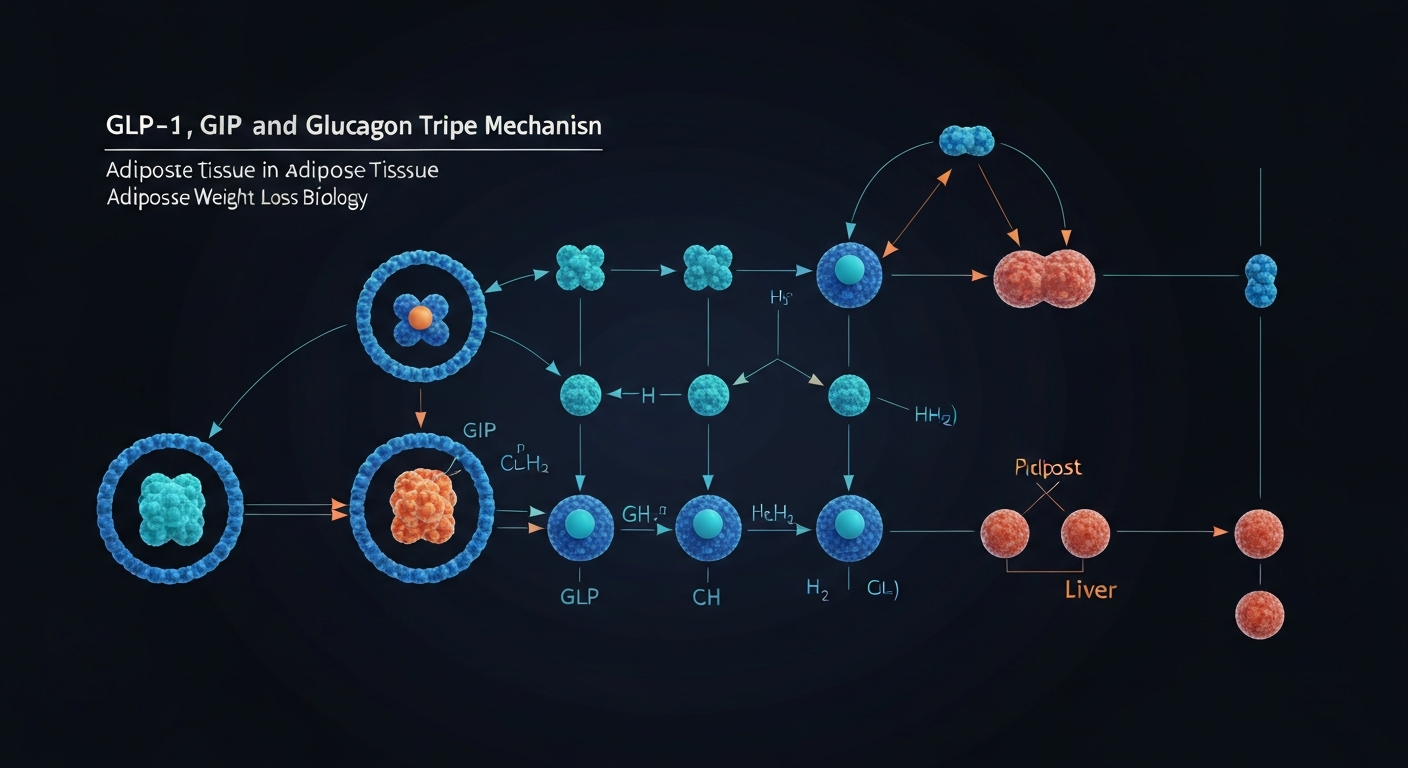
The Phase 2 retatrutide obesity trial published in the New England Journal of Medicine in 2023 is worth reading carefully, because the numbers require some context to interpret correctly. The 24.2% average body weight loss at the 12 mg dose over 48 weeks is the headline — but the trial also showed a weight loss trajectory that hadn't plateaued at the end of the study period. Most GLP-1 agonist trials show a leveling-off curve; retatrutide's curve in Phase 2 was still descending at week 48, suggesting the plateau weight may be even lower with longer treatment. That's an unusual efficacy signal for an incretin-class compound, and it's driven by the triple agonist mechanism — specifically, the glucagon receptor component that adds energy expenditure on top of the appetite suppression from GLP-1 and the insulinotropic effects from GIP.
The liver fat data from Phase 2 is probably underreported in popular coverage. Retatrutide produced an 81.3% relative reduction in liver fat content by MRI-PDFF over 24 weeks in patients with baseline hepatic steatosis — a remarkable result for a compound targeting obesity. NASH (now called MASH) is frequently comorbid with obesity, and the current pharmacological options for liver fat reduction are limited. That retatrutide addresses both endpoints through a single mechanism is one of the reasons Eli Lilly has included liver-specific endpoints in the TRIUMPH Phase 3 program, with the compound being evaluated as a potential treatment for metabolic dysfunction-associated steatotic liver disease (MASLD) in parallel with its obesity indication.
This guide covers how retatrutide drives weight loss through its triple-receptor pharmacology, what the full Phase 2 dataset shows on body weight trajectory, liver fat, glycemic control, and adverse events, comparisons with semaglutide and tirzepatide, and the Phase 3 program timeline and regulatory expectations. Everything links to primary sources.
Published research shows that Retatrutide stimulates Glucagon-like peptide 1 (GLP-1), Glucose-dependent insulinotropic polypeptide (GIP) receptors, and glucagon receptors with balanced potency. The triple agonism integrates three weight-loss mechanisms:
According to the Phase 2 obesity trial paper, Retatrutide (LY3437943) is an agonist of the glucose-dependent insulinotropic polypeptide, glucagon-like peptide 1, and glucagon receptors with balanced affinity at all three. Published data confirms that Retatrutide is a novel triple receptor agonist peptide that targets the glucagon receptor in addition to the dual incretin receptors, providing the energy expenditure pillar that distinguishes the triple-hormone-receptor agonist retatrutide from the dual agonist tirzepatide.
Phase 2 obesity trial results by dose over 48 weeks:
How quickly? Body weight curves separate from placebo within 4-6 weeks of consistent dosing. By week 4 (typical question for new users), expected weight loss is 1-3 percent of body weight depending on starting weight and dose-escalation pace. Visible body composition changes appear by week 12; the bulk of the eventual effect accumulates over weeks 16-48.
Based on available indirect-comparison data:
According to the SURMOUNT-1 tirzepatide trial paper, Tirzepatide once weekly provided substantial and sustained reductions in body weight in adults with obesity. The retatrutide data exceeds this magnitude on indirect comparison. A direct head-to-head Phase 3 trial has not been published, but the indirect evidence supports retatrutide as the most potent weight-loss intervention in clinical development.
The receptor-pharmacology difference is documented. Published research shows that the dual agonist shows imbalance toward GIP receptor, combined with distinct signaling properties at the GLP-1 receptor, providing complementary effects across the two pathways. Retatrutide adds glucagon receptor activation as a third pillar.
Yes, more selectively than semaglutide. The glucagon receptor activation component drives energy expenditure through liver gluconeogenesis suppression of glucose disposal and brown adipose tissue activation, which means a larger fraction of the total weight loss is fat mass rather than lean mass compared with the GLP-1-only class. DEXA substudies in Phase 2 trials reported approximately 75-85 percent of weight loss as fat mass at top doses, versus 60-75 percent typical for semaglutide. The triple-agonist mechanism partially preserves lean mass by maintaining cellular energy expenditure rather than relying entirely on caloric reduction.
Phase 2 dose escalation was: 2 mg weekly for 4 weeks → 4 mg weekly for 4 weeks → 8 mg weekly for 4 weeks → 12 mg weekly as the maintenance dose (for the top cohort). The escalation period manages GI tolerability; faster escalation increases adverse-event rates. The Phase 3 TRIUMPH program uses a similar schedule with maintenance doses of 4, 8, and 12 mg. Subcutaneous injection administered once weekly is the standard route. The peptide is supplied as a finished sterile solution for clinical trials; research-grade material is supplied as lyophilised powder for reconstitution.
The Phase 2 adverse-event profile is dominated by gastrointestinal symptoms:
The glucagon receptor component raises theoretical concerns about hepatic glucose production in non-diabetic populations, but Phase 2 data does not show clinically meaningful hyperglycaemia. The most material near-term safety signal is the higher GI-related discontinuation rate compared with tirzepatide at equivalent dose-scaled positions.
Retatrutide is not yet approved. The Phase 3 TRIUMPH program initiated in 2022 with key readouts expected through 2026-2027. Health Canada and FDA approval is plausible in 2027 or 2028. Pricing is likely to be in the same range as tirzepatide (Zepbound), roughly CAD 600-700 per month at retail.
The retatrutide development program covers multiple indications beyond obesity:
The breadth of metabolic effect makes retatrutide one of the most consequential research peptides in current development.
Yes, currently. The Phase 2 and Phase 3 programs use subcutaneous injection once weekly. An oral retatrutide formulation has been discussed as a future development direction but is not in current trials. Like other peptide-based incretin agonists, oral bioavailability requires either prodrug strategies (as with oral semaglutide/Rybelsus) or absorption-enhancer co-formulation.
The Phase 3 program enrols adults with BMI ≥30 (obesity) or BMI ≥27 with comorbidities (overweight with comorbidity). Type 2 diabetes patients are enrolled in parallel programs. Exclusions include personal or family history of medullary thyroid carcinoma, multiple endocrine neoplasia syndrome type 2, severe gastroparesis, type 1 diabetes, pregnancy, and active eating disorders. The compound is not appropriate for unmonitored use outside of clinical trials.
Retatrutide is not yet approved by any regulatory body. Research-grade material is legal in Canada and the United States as a research chemical sold under research-use-only labelling, distinct from any future finished pharmaceutical. The peptide is not on the World Anti-Doping Agency prohibited list, though athletes should monitor for regulatory updates.
Reproducible incretin research depends on the integrity of the input material. Reviv Peptides supplies research-grade retatrutide with third-party COA and HPLC purity. View the Retatrutide product page.
Phase 2 data: 8.7% at 1 mg, 17.1% at 4 mg, 22.8% at 8 mg, 24.2% at 12 mg over 48 weeks. Curves separate from placebo within 4-6 weeks; visible body composition changes by week 12.
Based on indirect Phase 2 comparison: yes. Retatrutide (24.2%) exceeds tirzepatide (20.9%) and semaglutide (14.9%) on weight loss magnitude at top doses. Head-to-head Phase 3 data is not yet published.
GI-dominant: nausea (30-50% at top doses), vomiting, diarrhoea, constipation. Injection-site reactions, modest heart rate increase. Rare pancreatitis. Theoretical thyroid C-cell tumour signal. Discontinuation rates 6-16% depending on dose.
More selectively than semaglutide. The glucagon receptor activation drives energy expenditure, with 75-85% of weight loss as fat mass at top doses vs 60-75% for semaglutide. Partially preserves lean mass.
Once weekly subcutaneous injection with stepwise escalation: 2 mg → 4 mg → 8 mg → 12 mg, each step for 4 weeks. Maintenance dose continues indefinitely. Faster escalation increases GI adverse events.
Key data point: The Phase 2 RETATRUTIDE trial (PMID 37390186) showed that participants completing 48 weeks at 12 mg had a mean absolute weight loss of 29.3 kg — greater than average weight loss from bariatric sleeve gastrectomy in observational studies, making it the highest weight-loss efficacy ever documented for a non-surgical intervention in a randomised controlled trial.
Retatrutide weight loss is the largest pharmacological weight reduction reported in clinical research to date, with 24.2 percent average body weight loss over 48 weeks at the 12 mg dose. The triple-agonist mechanism (GLP-1, GIP, glucagon receptor) integrates appetite suppression, insulinotropic effects, and elevated energy expenditure into a single weekly subcutaneous injection. The Phase 3 TRIUMPH program is underway; Health Canada and FDA approval is plausible in 2027-2028. Side-effect profile shares the GI-dominant signature of the incretin class with slightly higher rates at top doses than tirzepatide. Research-grade material is legal in Canada and the United States under research-use-only labelling.
All products sold by Reviv Peptides are for research and educational purposes only and are not intended for human consumption.

The Reviv Peptides Research Team is a collective of science writers and researchers dedicated to producing evidence-based, peer-reviewed-grade content about research peptides. Our work focuses on molecular mechanisms, receptor pharmacology, and preclinical data — including GLP-1/GIP/glucagon incretin biology, growth hormone axis peptides (GHRH analogs and ghrelin-receptor secretagogues), mitochondrial-derived peptides (MOTS-c, SS-31), tissue-repair peptides (BPC-157, TB-500, GHK-Cu), and nootropic peptides (Semax, Selank). All content is written in a strict preclinical/laboratory context; none of our editorial material is intended as medical advice. Every guide is reviewed for scientific accuracy against published peer-reviewed literature.
A mechanistic ranking of weight-loss peptides studied in 2026: GLP-1s, GLP-1/GIP, triple agonists, AOD-9604, 5-Amino-1-MQ, and tesamorelin.

Semax is an ACTH(4-10) analog that elevates BDNF; Selank is a tuftsin analog modulating GABA and immune pathways. Full comparison.
No account yet?
Create an Account