
Best Peptides for Weight Loss in 2026: A Mechanistic Guide
A mechanistic ranking of weight-loss peptides studied in 2026: GLP-1s, GLP-1/GIP, triple agonists, AOD-9604, 5-Amino-1-MQ, and tesamorelin.

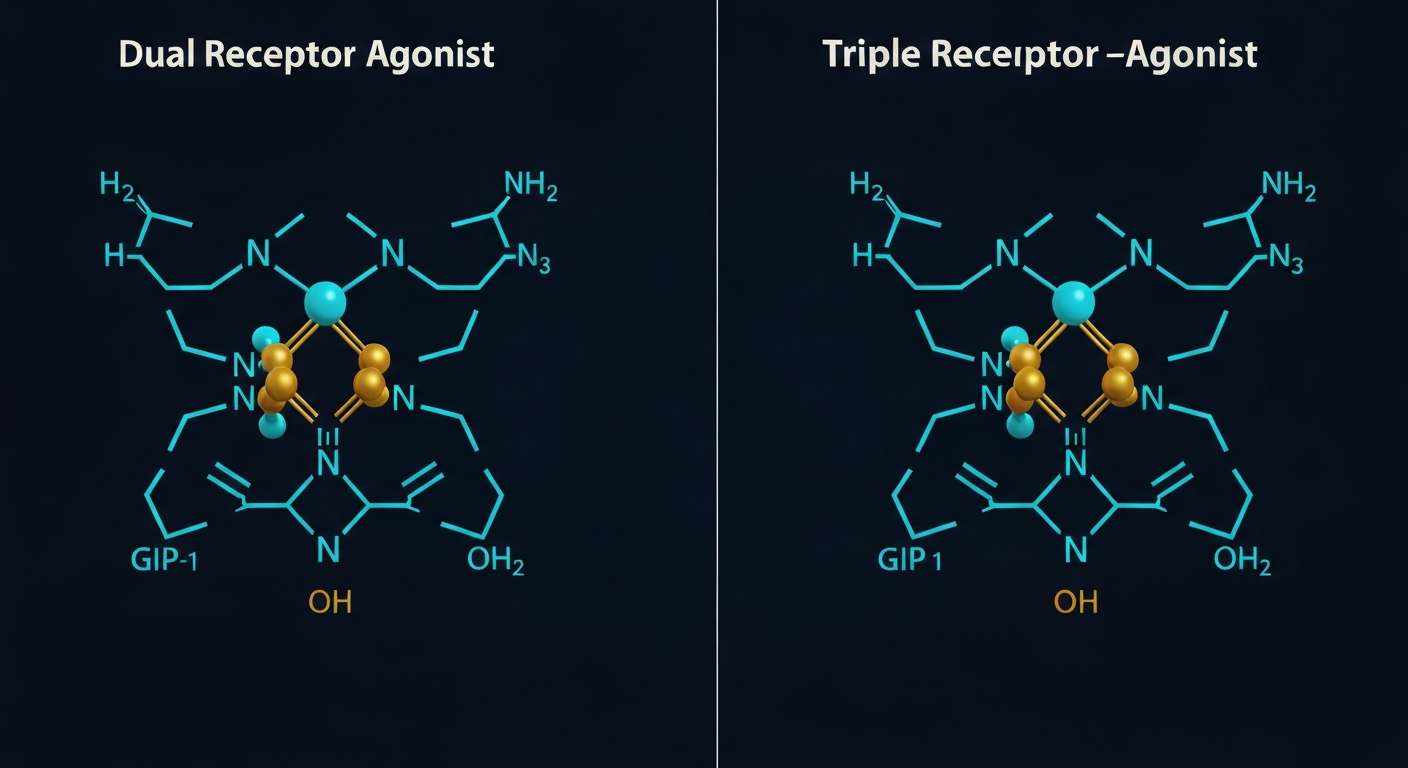
Retatrutide vs tirzepatide is, at its core, a question about whether adding glucagon receptor agonism to a dual incretin framework actually earns its keep. Tirzepatide (Mounjaro/Zepbound) produced 20.9% average weight loss at the 15 mg dose in the SURMOUNT-1 trial over 72 weeks — a number that redefined what pharmacological weight loss looked like. Retatrutide then posted 24.2% at the 12 mg dose over 48 weeks in Phase 2, in a shorter timeframe. That gap is real, but the comparison isn't perfectly apples-to-apples: different trial populations, different timepoints, no head-to-head RCT between them yet. The mechanistic difference — that third glucagon receptor — is well-defined even if the clinical equivalence question isn't fully answered.
Here's what the glucagon receptor adds that GLP-1 and GIP alone don't provide: thermogenesis. GLP-1 agonism reduces caloric intake through appetite suppression and slowed gastric emptying. GIP potentiates the insulinotropic response and may amplify adipose fat mobilization. Glucagon receptor agonism increases hepatic glucose output (a liability in isolation) but also drives energy expenditure through brown adipose tissue activation and increased metabolic rate — an effect that's partially independent of caloric intake reduction. In retatrutide, the ratio of GLP-1 to GIP to glucagon receptor activity is tuned to maintain glycemic safety while capturing that energy-expenditure benefit. Whether that balance holds at scale across a diverse Phase 3 population is what the ongoing TRIUMPH trials will establish.
This guide covers the mechanistic differences between retatrutide and tirzepatide at the receptor level, what the available Phase 2 and Phase 3 data shows on weight loss, glycemic endpoints, and side effects, how the two compounds compare on lipid markers and liver fat, and what researchers and clinicians should understand about the current evidence gap. Every claim traces to primary literature.
Both compounds are subcutaneous-injection peptides that activate incretin-class receptors on multiple tissues. Tirzepatide engages two receptors; retatrutide engages three.
According to the original PubMed-indexed pharmacology paper, Tirzepatide (LY3298176) is a dual GIP and GLP-1 receptor agonist with balanced potency at both receptors. The two-receptor activation produces appetite suppression and slowed gastric emptying (GLP-1 effects), plus insulinotropic and central appetite effects (GIP).
Published research shows that Retatrutide is a novel triple receptor agonist peptide that targets the glucagon receptor in addition to GLP-1 and GIP. According to the Phase 2 trial paper, Retatrutide (LY3437943) is an agonist of the glucose-dependent insulinotropic polypeptide, glucagon-like peptide 1, and glucagon receptors with balanced affinity that allows simultaneous activation of all three pathways. The added glucagon receptor activation raises energy expenditure, providing a third pillar that the dual agonist does not engage.
Based on available indirect-comparison evidence, yes — retatrutide produces larger absolute weight loss at the top studied doses. The data comparison:
According to the SURMOUNT-1 tirzepatide trial paper, Tirzepatide once weekly provided substantial and sustained reductions in body weight over 72 weeks in adults with obesity. Published research shows that Retatrutide showed clinically meaningful improvements in glycaemic control and robust reductions in bodyweight in type 2 diabetes patients, with effect sizes that consistently exceed tirzepatide at comparable doses. A head-to-head Phase 3 trial has not yet been published; the comparison rests on indirect evidence from separate trial programs.
The most important differences for research and clinical decision-making:
Both compounds share the GI-dominant adverse event profile of the incretin class:
Retatrutide’s adverse event rates are slightly higher than tirzepatide at top doses (6-16 percent discontinuation vs 4-10 percent for tirzepatide), but the side effects remain in the same shape rather than introducing new categories. The glucagon receptor activation in retatrutide does not appear to drive clinically meaningful hyperglycaemia in non-diabetic populations.
Both compounds use once-weekly subcutaneous injection with dose escalation:
The escalation periods exist to manage GI tolerability; faster escalation increases adverse-event rates. Both compounds support continued dosing at the maintenance dose indefinitely; discontinuation typically allows weight to return toward baseline over 6-12 months.
Appetite suppression effects appear within 1-3 days of the first dose. Subjective effects on energy and metabolism are subtle and accumulate over weeks. Body weight curves diverge from placebo within 4-8 weeks of consistent dosing. The GI side effects (nausea in particular) appear strongest in the first 1-2 weeks of each dose escalation, then attenuate as the body adapts to the receptor activation pattern. Tirzepatide follows a similar timeline.
In research and (eventually) clinical contexts, switching is feasible. The half-lives are similar (5-7 days for both), so a one-week washout allows clean transition. The GI side effects often re-emerge after switching because the new compound has different receptor-activation patterns; restart from a lower dose and escalate rather than matching the previous maintenance dose. Switching protocols are not yet formally validated in late-phase trials since retatrutide is not approved.
For obesity without diabetes, both compounds work well. Retatrutide’s larger weight loss effect at the top dose makes it the more potent option in research data. The glucagon receptor activation could theoretically raise glucose in non-diabetic subjects, but Phase 2 data does not show clinically meaningful hyperglycaemia. For approved-medication access today, tirzepatide is the only choice; retatrutide remains experimental.
Retatrutide is in the Phase 3 TRIUMPH program (initiated 2022, key readouts expected 2026-2027). Health Canada and FDA approval is plausible in 2027 or 2028 if Phase 3 data continues to support the Phase 2 efficacy signal. Until approval, research-grade retatrutide is available in Canada and the United States only as a research chemical under research-use-only labelling.
Tirzepatide (Zepbound) costs roughly CAD 600-700 per month at retail in Canada and the United States. Insurance coverage varies; some private plans cover the obesity indication, public plans generally do not. When retatrutide is approved, pricing is likely to be in the same range as tirzepatide. Until then, neither compound is in cost-effectiveness territory for general population obesity treatment without insurance support.
Tirzepatide is FDA-approved in the United States and Health Canada-approved as Mounjaro (T2D, 2024). Retatrutide is not yet approved anywhere. Research-grade material for both is legal in Canada and the United States as research chemicals sold under research-use-only labelling. Neither is on the World Anti-Doping Agency prohibited list.
Reviv Peptides supplies research-grade retatrutide and tirzepatide with third-party COA and HPLC purity confirmation. View Retatrutide or Tirzepatide.
Based on indirect comparison: yes. Retatrutide produces 24.2% weight loss at 12 mg over 48 weeks vs tirzepatide’s 20.9% at 15 mg over 72 weeks. A head-to-head Phase 3 trial has not been published.
Tirzepatide is a dual GLP-1/GIP agonist (FDA-approved); retatrutide is a triple GLP-1/GIP/glucagon agonist (experimental). The added glucagon receptor activation adds an energy-expenditure component. Both use once-weekly subcutaneous dosing.
Top-dose weight loss: retatrutide 24.2%, tirzepatide 20.9%, semaglutide 14.9%. Effect sizes are dose-dependent and the comparisons rest on indirect data from separate trial programs.
Both share GI-dominant adverse event profiles: nausea, vomiting, diarrhoea, constipation, injection-site reactions. Retatrutide’s rates are slightly higher at top doses. Rare pancreatitis is a precautionary class warning.
Not yet FDA or Health Canada-approved. Phase 3 TRIUMPH program key readouts expected 2026-2027; approval plausible 2027-2028.
Key data point: Direct comparison: Tirzepatide dual GIP/GLP-1 agonism produced approximately 22% mean weight loss in SURMOUNT-1 at 72 weeks; Retatrutide added roughly 2–3 percentage points through its glucagon receptor component, which specifically targets hepatic lipid oxidation and thermogenic gene expression in brown adipose tissue — pathways that GLP-1 and GIP agonism do not directly engage.
Retatrutide and tirzepatide represent successive generations of incretin-class weight management peptides. Tirzepatide is the FDA-approved dual GLP-1/GIP agonist with 20.9 percent average weight loss at top dose. Retatrutide is the experimental triple agonist (GLP-1, GIP, and glucagon receptor) with 24.2 percent average weight loss in Phase 2. The mechanism difference is the glucagon receptor activation that adds energy expenditure to the appetite-and-insulin effects of the dual agonist. Both compounds share the GI-dominant side effect profile of the incretin class; retatrutide’s rates are slightly higher at top doses. Tirzepatide is the only approved option today; retatrutide remains in Phase 3 trials. Research-grade material for both is legal in Canada and the United States under research-use-only labelling.
All products sold by Reviv Peptides are for research and educational purposes only and are not intended for human consumption.

The Reviv Peptides Research Team is a collective of science writers and researchers dedicated to producing evidence-based, peer-reviewed-grade content about research peptides. Our work focuses on molecular mechanisms, receptor pharmacology, and preclinical data — including GLP-1/GIP/glucagon incretin biology, growth hormone axis peptides (GHRH analogs and ghrelin-receptor secretagogues), mitochondrial-derived peptides (MOTS-c, SS-31), tissue-repair peptides (BPC-157, TB-500, GHK-Cu), and nootropic peptides (Semax, Selank). All content is written in a strict preclinical/laboratory context; none of our editorial material is intended as medical advice. Every guide is reviewed for scientific accuracy against published peer-reviewed literature.
A mechanistic ranking of weight-loss peptides studied in 2026: GLP-1s, GLP-1/GIP, triple agonists, AOD-9604, 5-Amino-1-MQ, and tesamorelin.

Semax is an ACTH(4-10) analog that elevates BDNF; Selank is a tuftsin analog modulating GABA and immune pathways. Full comparison.
No account yet?
Create an Account