KLOW vs GLOW Peptide Blends: What’s the Difference?
Ask five researchers what separates the KLOW and GLOW peptide blends and you’ll get five slightly different answers. That’s a

Part of our overview of immune, reproductive and specialty peptides.
Kisspeptin-10 is a small 10-amino-acid peptide. It switches on the body’s reproductive hormone system. It works on a receptor called GPR54 in the brain. Flipping that switch tells the body to release the hormones that drive testosterone in men and estrogen in women.[1] This guide covers what kisspeptin-10 does and how it works through the HPG axis. It also covers what the studies show and what to check when sourcing it.
The effect is fast and well documented. In healthy men, a single injection raises the hormone LH within about 30 minutes.[1] That speed matters. It lays bare how the reproductive system is actually wired. The brain’s GnRH cells don’t respond to most signals directly. What they answer to is kisspeptin. Switch that receptor off and the whole reproductive chain falls silent. Switch it on and the chain fires.
Research-use disclaimer: kisspeptin-10 is sold for laboratory research only. It isn’t a drug, supplement, or treatment. It isn’t for human use. The notes below describe published lab and human studies, not medical advice.
Kisspeptin-10 is the 10-amino-acid tail of the larger kisspeptin-54 peptide. Older papers sometimes call that parent peptide metastin. George and colleagues, in the Journal of Clinical Endocrinology & Metabolism, showed it’s the shortest piece that still fully activates the GPR54 receptor.[1] That’s what makes it the standard tool for studying kisspeptin signaling. It binds the receptor tightly. Then it sets off a calcium-based signal inside the brain’s GnRH cells.
What follows is a GnRH pulse. The key detail is that kisspeptin-10 acts above GnRH. It never pokes the pituitary directly. The GnRH it releases then signals the pituitary to put out LH and FSH. Those two go on to drive testosterone from the testes in men and estradiol from the ovaries in women.
GPR54 is the gatekeeper of the reproductive hormone chain, the HPG axis. Its job stayed a mystery until 2003. That’s when researchers discovered that broken versions of the gene cause a hormone disorder. Rhie, writing in the Annals of Pediatric Endocrinology & Metabolism, describes how loss-of-function mutations in that gene showed up in patients with hypogonadotropic hypogonadism.[2] That proved the kisspeptin receptor system controls the whole axis. It also gates the start of puberty.
The brain’s kisspeptin cells actually come in two crews. The AVPV group drives the LH surge in females. The ARC group sets the steady GnRH pulse pattern that holds baseline hormone levels in both sexes. Both crews wire into the GnRH cells and signal through that same receptor.
In studies of healthy men, kisspeptin-10 produces a quick, dose-dependent rise in serum LH within 30 minutes. A slower testosterone climb follows, peaking around 60 to 120 minutes. Jayasena and colleagues, in Human Reproduction, found it may lift reproductive hormones in a more natural way than a direct GnRH drug.[3] The reason is that it triggers the body’s own GnRH pulses instead of forcing the signal.
The typical study doses run 0.3 to 10 micrograms per kilogram into a vein. Subcutaneous doses run 1 to 100 micrograms. At standard research doses, testosterone rises of 20 to 40 percent above baseline get reported within 90 minutes. The exact bump depends on the subject’s baseline hormone tone and testicular reserve. Crucially, the response still works in older men. That is exactly why kisspeptin-10 gets studied as a research tool for age-related testosterone decline.
Hypogonadotropic hypogonadism (HH) is the research setting where kisspeptin-10 has shown its most striking effects. Young and colleagues, in Neuroendocrinology, showed that a steady kisspeptin infusion restored pulsatile LH secretion in patients with certain receptor-signaling defects.[4] That worked specifically in those whose downstream GnRH receptor was still intact. Sonigo, reviewing the field in the Annales d’Endocrinologie, frames kisspeptin agonists as promising new research tools for reproductive problems in both men and women.[5] The possible uses span HH, polycystic ovary syndrome, IVF trigger protocols, and male hypogonadism research.
In research, kisspeptin-10 raises the body’s own LH and testosterone in men with a working HPG axis. It’s studied for male hypogonadism and age-related testosterone decline. It also serves as a tool to test pituitary-gonadal reserve. Here’s the appealing part. Taking testosterone directly shuts testicular function down. Kisspeptin-10 works upstream and keeps that function ticking over instead. That’s the very same reason researchers eye kisspeptin agonists for restarting the body’s own hormone axis in steroid-recovery research.
The traditional post-cycle-therapy compounds all work at different points in the chain. Clomiphene and tamoxifen block estrogen feedback at the brain and pituitary, which indirectly bumps up GnRH. hCG mimics LH and pokes the testes directly, skipping the brain and pituitary entirely. Kisspeptin-10 sits above all three. It switches on the body’s own kisspeptin-GPR54-GnRH path. That produces a natural, pulsing hormone release that copies the body’s rhythm. In research terms, that natural-pulse mechanism is the strongest case for kisspeptin-10 over the older PCT options.
Published research protocols use the peptide a few ways. For acute pituitary-gonadal axis testing, they give 0.3 to 10 micrograms per kilogram as an IV bolus. For repeated dosing in research protocols, it’s 1 to 100 micrograms subcutaneous. And for HH research, a continuous low-rate infusion under the skin is common. It arrives as a freeze-dried powder. You mix it with bacteriostatic water before use. Its half-life is short, roughly 30 minutes by IV. So pulsing or continuous dosing beats a single shot for any lasting-effect research. Dosing frequency across research models ranges from twice a day to continuous infusion, depending on the endpoint.
The reported side effects in the published human studies are minimal. They are mostly short-lived injection-site reactions, a mild headache, and the occasional flushing. No liver, heart, or off-target hormone signals have been recorded. The mechanism is tightly focused on the HPG axis. So the peptide doesn’t stir up other hormone systems. The published research shows no effect on prolactin, ACTH, or thyroid.
There are two cautions worth flagging. The first is pregnancy. The kisspeptin system helps maintain pregnancy, and outside stimulation could disrupt it. The second is use alongside a GnRH-receptor blocker, since a downstream block simply cancels the upstream signal. On the whole, kisspeptin-10 is well tolerated. Still, safety beyond about 6 months of dosing hasn’t been fully studied in humans.
Kisspeptin-54 is the longer parent peptide, all 54 amino acids of it. Kisspeptin-10 is the 10-amino-acid tail that still fully activates the receptor. Both grip the receptor about equally. But they differ in half-life and in how they spread through tissue. Kisspeptin-10 is shorter, easier to make, and faster-acting. Kisspeptin-54 lingers longer in the blood. So research generally reaches for kisspeptin-10 on quick HPG-axis tests. It reaches for kisspeptin-54 on the longer-lasting protocols.
Kisspeptin-10 has no Health Canada or FDA approval. It is sold only as a research-use-only chemical. It wasn’t on the World Anti-Doping Agency banned list as of 2026. Our guide to buying peptides in Canada explains how these rules work.
The warning signs of a bad batch are easy to spot once you know them. Walk away if the vial ships with no batch-specific Certificate of Analysis. Walk away too if the COA is vague, listing a purity number but no matching batch code. Treat a lone HPLC figure like “98 percent” with no chromatogram trace as another red flag. The trace is what shows whether one clean peak or a cluster of side-products sits behind that number. The biggest tell is the mass-spectrometry result. Kisspeptin-10 is a decapeptide with an expected mass near 1,302 Da. An MS readout that lands far from that figure means you are not holding the peptide on the label. For any in-vivo or cell-culture work, missing endotoxin and sterility data is a final deal-breaker.
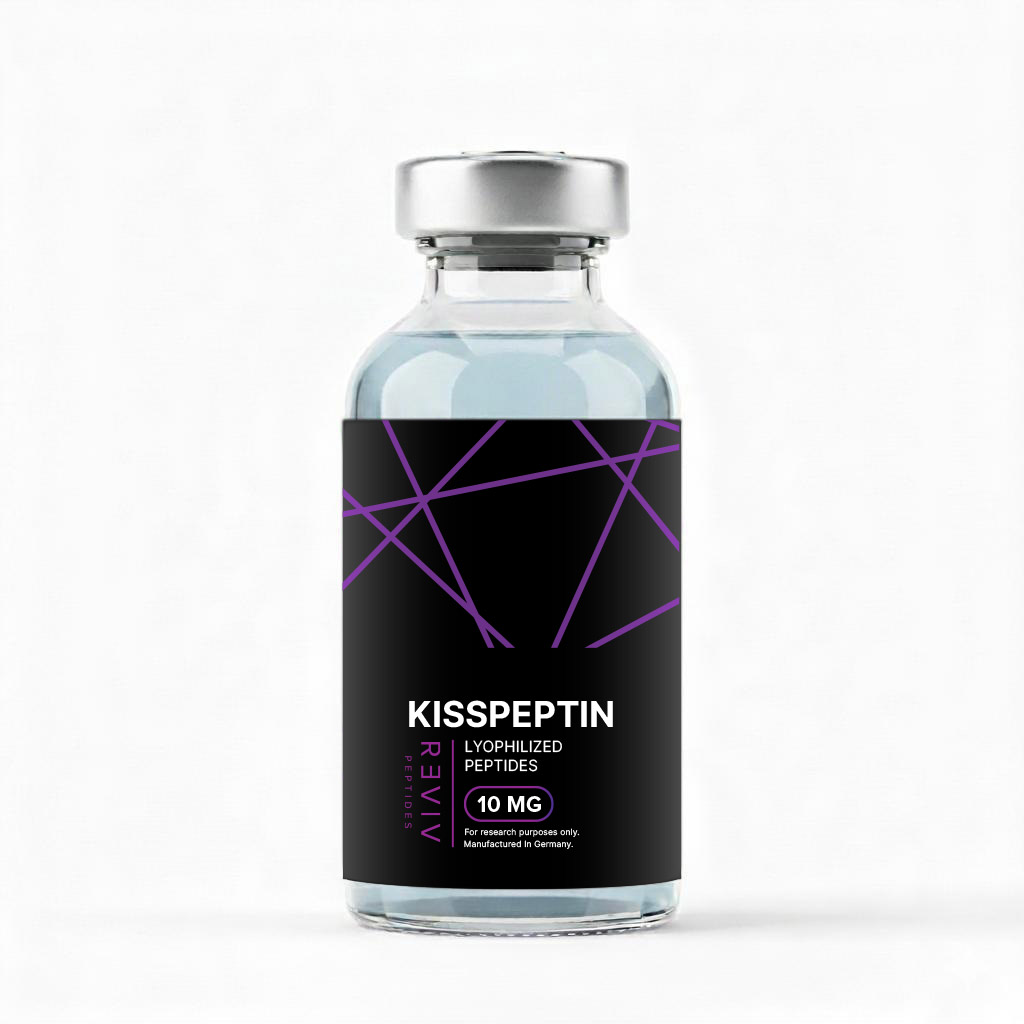
Reviv Peptides supplies kisspeptin-10 at 10 mg per vial with a third-party COA and HPLC purity confirmation. View the Kisspeptin-10 10mg product page.
In research, it raises the body’s own LH, FSH, and testosterone through the GPR54-GnRH path. The uses include male and female hypogonadism research, hypogonadotropic hypogonadism, polycystic ovary syndrome, IVF trigger protocols, and testing pituitary-gonadal reserve.
Single doses raise testosterone 20 to 40 percent above baseline within 90 minutes in healthy men. The response is dose-dependent. It still works in older men with intact testicular reserve.
Published research protocols use 0.3 to 10 micrograms per kilogram by IV bolus or 1 to 100 micrograms subcutaneous. The half-life is short, about 30 minutes. So pulsing or continuous dosing is preferred for lasting research endpoints.
It binds GPR54 on the brain’s GnRH cells, triggering a GnRH pulse through a calcium-based signal. That GnRH then drives pituitary LH and FSH, which stimulate the gonads. The mechanism keeps the natural pulsing rhythm intact.
In research, it reliably raises the body’s own LH and testosterone in men with a working HPG axis. It’s studied for male hypogonadism, age-related testosterone decline, and axis-recovery research. The upside is that it keeps testicular function going instead of shutting it down.
Key data point: George and colleagues (2011, JCEM) showed that kisspeptin-10 is a potent stimulator of LH and increases LH pulse frequency in healthy men.[1] That finding pinned down its role as the minimal active fragment for probing the kisspeptin-GPR54-GnRH axis.
Kisspeptin-10 is the standard tool peptide for HPG-axis research. It’s the shortest active piece of kisspeptin that still fully activates GPR54. From there it drives the body’s own GnRH pulses, LH and FSH release, and the downstream testosterone and estradiol. Its strongest published uses are in hypogonadotropic hypogonadism research and male hypogonadism studies. It also serves as an upstream alternative to the traditional PCT compounds. The safety picture looks good and the human evidence base is moderate. Medical approval doesn’t yet exist. For reproductive-hormone researchers, kisspeptin-10 is the cleanest tool for probing the kisspeptin-GPR54-GnRH axis.
Sources: [1] Kisspeptin-10 is a potent stimulator of LH and increases pulse frequency in men (George et al., 2011), PubMed. [2] Kisspeptin/GPR54 system as a gatekeeper of pubertal development (Rhie, 2013), PubMed. [3] Direct comparison of IV kisspeptin vs GnRH on gonadotropins in men (Jayasena et al., 2015), PubMed. [4] Kisspeptin restores pulsatile LH secretion in signaling deficiencies (Young et al., 2013), PubMed. [5] Overview of the impact of kisspeptin on reproductive function (Sonigo et al., 2012), PubMed.

The Reviv Peptides Research Team is a collective of science writers and researchers dedicated to producing evidence-based, peer-reviewed-grade content about research peptides. Our work focuses on molecular mechanisms, receptor pharmacology, and preclinical data — including GLP-1/GIP/glucagon incretin biology, growth hormone axis peptides (GHRH analogs and ghrelin-receptor secretagogues), mitochondrial-derived peptides (MOTS-c, SS-31), tissue-repair peptides (BPC-157, TB-500, GHK-Cu), and nootropic peptides (Semax, Selank). All content is written in a strict preclinical/laboratory context; none of our editorial material is intended as medical advice. Every guide is reviewed for scientific accuracy against published peer-reviewed literature.
Ask five researchers what separates the KLOW and GLOW peptide blends and you’ll get five slightly different answers. That’s a

A plain-language guide to the Canadian legal framework around peptides and the supplier criteria researchers should actually verify.
Discount Applied Successfully!
Your savings have been added to the cart.
Each tier you reach gives you more. Open one to see what it unlocks.
See what it takes to reach each tier.
Highest tier
Each tier you reach gives you more. Open one to see what it unlocks.
See what it takes to reach each tier.
Highest tier