
Buying Peptides in Canada: Legal Framework & Supplier Criteria
A plain-language guide to the Canadian legal framework around peptides and the supplier criteria researchers should actually verify.

This guide is part of our broader overview of peptides for healing and recovery.
KPV is a tiny three-amino-acid peptide, Lys-Pro-Val, studied mostly for calming inflammation, and especially for calming it in the gut. It’s the tail end of a bigger hormone called alpha-MSH. The neat part: it keeps that hormone’s anti-inflammatory punch while shedding the baggage, the skin darkening, the blood-pressure bump, the appetite shifts.[1] This guide covers what it is, how it works, what the studies show, and what to check when sourcing it.
The most interesting work is in the gut. Dalmasso and colleagues, in Gastroenterology, showed it’s carried into gut-lining cells by a transporter called PepT1, the same one that ferries small food peptides.[2] That’s a big deal. It means oral KPV can reach the gut lining in active amounts without an injection, which is unusual, because most peptides fall apart fast down there. In colitis models, it lowers tissue damage, drops the inflammatory signaling, and speeds healing. And it doesn’t flatten the whole immune system to do it. It works the inflammation pathway specifically.
Research-use disclaimer: KPV is sold for laboratory research only. It isn’t a drug, supplement, or treatment, and it isn’t for human use. The notes below describe published lab and animal studies, not medical advice.
In research it’s a tool, two tools really. One, a probe for how the melanocortin pathway calms inflammation. Two, a test compound in animal models of inflammatory bowel disease and gut inflammation. It lets researchers study alpha-MSH’s anti-inflammatory side without the parent hormone’s long side-effect list. The reported uses span ulcerative colitis and Crohn’s models, contact dermatitis, atopic skin flares, and post-surgery wound inflammation. No regulator has cleared it for medical use, so it stays a laboratory research compound.
It gets inside cells and flips off an inflammation switch. As the last three amino acids of alpha-melanocyte-stimulating hormone, it carries the parent hormone’s calming action in a far smaller package, something Sun and colleagues, in ACS Biomaterials Science & Engineering, leaned on when they built a KPV-releasing hydrogel.[1] It rides into gut-lining cells on PepT1 and acts inside the cell rather than docking on a surface receptor.
That inside-the-cell step is blocking NF-κB, the master switch for inflammation. The Dalmasso study found that even nanomolar amounts shut down the NF-κB and MAP kinase pathways.[2] Turn NF-κB down and the cell churns out fewer inflammatory cytokines, the TNF-alpha, IL-1beta, and IL-6 that do the damage, so less gut-lining injury follows. That drop in the immune response is the bridge between the peptide and the calm seen in colitis models.
The benefits reported in published animal and cell studies sort into a few buckets, and these are research findings, not promises. In inflammatory bowel disease, it lowers tissue damage, weight loss, and gut-lining injury across the DSS and TNBS colitis models. In skin, contact and atopic dermatitis models show less swelling and fewer immune cells after topical dosing. Wounds close a day or two faster in rodent skin-punch studies. And in long-running models of chronic inflammation, there’s less progression toward abnormal, pre-cancerous cells. On that last point, Viennois and colleagues, in Cellular and Molecular Gastroenterology and Hepatology, found the PepT1-carried tripeptide helped head off colitis-associated cancer.[3] So the effect seems to reach past short-term symptom relief into longer-term tissue protection.
IBD is where the dataset is strongest. Across DSS colitis, TNBS colitis, T-cell transfer colitis, and IL-10 knockout models, treated animals post lower disease scores, less tissue damage, and better survival than vehicle controls. The PepT1 route is what makes the oral version shine, and there’s a twist to it: inflamed gut tissue actually makes more PepT1, so the peptide gets pulled in right where it’s needed most.
Xiao and colleagues, in Molecular Therapy, loaded it into hyaluronic-acid nanoparticles and eased ulcerative colitis two ways at once, speeding gut healing and reshaping the gut microbiome, while homing in on the inflamed sections selectively.[4] Zooming out, Luger and colleagues, in the Annals of the Rheumatic Diseases, argued that the properties of alpha-MSH-related peptides could support oral formulations aimed straight at the gut lining, which is exactly where KPV development has gone.[5]
It fills a gap the usual drugs don’t. Next to 5-ASA (mesalamine), it hits a different target inside the cell, NF-κB rather than prostaglandin production. Next to anti-TNF biologics like infliximab and adalimumab, it doesn’t block one cytokine; it turns down the upstream switch that makes a whole batch of them. And next to corticosteroids, it sidesteps the body-wide immune suppression and shows no recorded stress-axis effects. In IBD research it’s framed as a gut-targeted add-on, not a stand-in for any existing class.
Research routes cover oral capsule, the most common in IBD work thanks to PepT1 uptake, plus topical for skin models, injection under the skin, and nasal spray. Oral and topical see the most use, because they drop the peptide right onto the inflamed tissue. Rodent doses range from 0.5 to 50 mg/kg per day depending on the route and model.
The preclinical side-effect profile is light. No oral lethal dose has shown up at any tested level. What does turn up in rodent studies is mild injection-site irritation with injected routes and a brief stomach upset at high oral doses. Because PepT1 delivers it mainly to target tissue, body-wide exposure stays low, which keeps the off-target trouble of broad immune suppressants off the table. The real gap is human data, which is basically absent, since KPV hasn’t been through large human trials.
For research, it carries one of the cleanest preclinical safety records among inflammation-pathway peptides. Whether it’s “worth it” comes down to the question you’re asking. For gut-lining inflammation or melanocortin anti-inflammatory mechanisms, it’s genuinely useful. For systemic inflammation outside the gut and skin, it’s less proven than other tools. The ceiling, again, is the missing human trial data. Any treatment claim simply doesn’t have the evidence behind it yet.
Neither Health Canada nor the FDA has approved KPV for medical use, so it is sold only as a research chemical under research-use-only labels, and it isn’t on the World Anti-Doping Agency banned list. Our guide to buying peptides in Canada explains that legal framework and how to vet a supplier.
Published DSS-colitis protocols usually run oral KPV at 0.5 to 5 mg/kg per day for 5 to 14 days. Intraperitoneal studies land between 0.1 and 1 mg/kg twice daily. Topical skin-model preps use 0.1 to 1 percent in saline or hydrogel. The oral PepT1 route is the cost-effective choice for long studies, while injection suits short pharmacology tests. For dose-response work in colitis, researchers tend to bracket around 1 mg/kg per day, where most of the published effects cluster.
Reliable results start with reliable material, so shop research peptides in Canada with full COA transparency.
Check the batch Certificate of Analysis against the tripeptide’s known mass. KPV is just three amino acids, Lys-Pro-Val, with a molecular weight of about 342 Da, so mass spectrometry on a genuine batch should read close to that number, and HPLC purity should be 98 percent or higher. Being a short tripeptide, it’s cheaper to make than larger peptides, but the checks still matter: insist the COA is batch-specific and from an independent third-party lab, and add endotoxin and sterility testing for any in-vivo work. A mass that misses 342 Da is the quickest tell that the vial isn’t what the label claims.
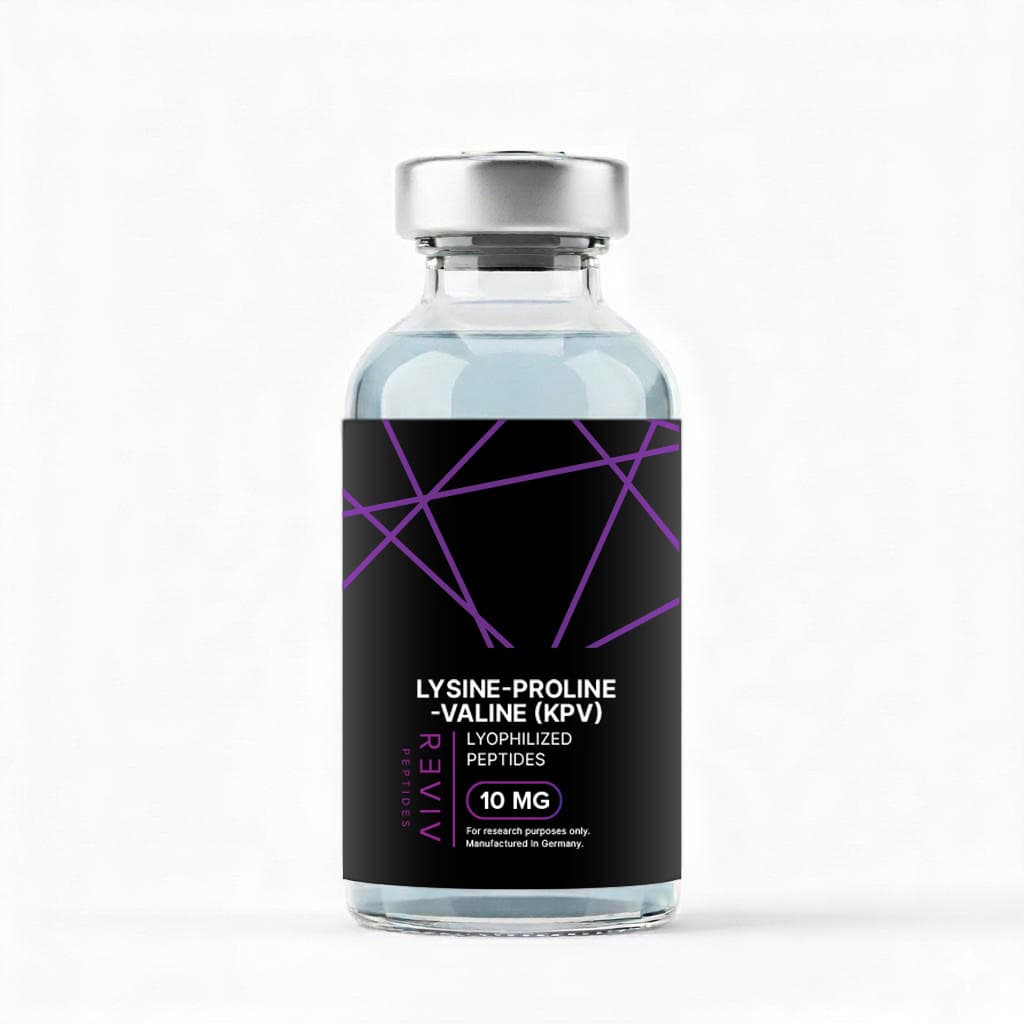
Reviv Peptides supplies KPV at 10 mg per vial with a third-party COA and HPLC purity confirmation. View the KPV 10mg product page.
In rodent research it lowers gut inflammation across DSS and TNBS colitis, speeds wound healing, eases contact dermatitis, and slows inflammation-linked cancer in chronic colitis models. The mechanism runs through NF-κB shutdown after PepT1 uptake.
Reported events in rodent studies are minimal: mild injection-site irritation and the occasional brief stomach upset at high oral doses. No body-wide immune suppression, and no liver or heart signals at standard preclinical doses.
Preclinical safety looks good; human safety data is basically absent. KPV is sold for research use only, and any treatment-use claim isn’t supported by current evidence.
For gut-lining inflammation and melanocortin anti-inflammatory research, it’s one of the most targeted tool peptides going. For inflammation outside the gut, other compounds may carry a stronger dataset.
PepT1 carries it into gut-lining cells, where it blocks the NF-κB and MAP kinase signals from the inside. The upshot is fewer inflammatory cytokines and a calmer overall response.
Key data point: in intestinal-cell and colitis work, nanomolar KPV delivered through PepT1 shut down NF-κB and MAP kinase signaling, cutting inflammatory cytokines and gut-lining damage without suppressing the immune system body-wide.[2]
KPV is the tail three amino acids of alpha-MSH, the part that keeps the hormone’s anti-inflammatory action without its side-effect list. Its main research uses are inflammatory bowel disease, gut-lining wound healing, and skin inflammation, all running through PepT1 uptake and NF-κB shutdown. It holds one of the cleanest preclinical safety records among inflammation-pathway peptides, though human trial data is basically absent. For researchers working on gut health or melanocortin biology, it’s a high-value tool peptide. For any treatment claim, the human evidence isn’t there to support a position yet.
Sources: [1] KPV tripeptide retains alpha-MSH anti-inflammatory activity (hydrogel delivery), PubMed. [2] PepT1-mediated KPV uptake reduces intestinal inflammation (NF-κB/MAPK), NIH/PMC. [3] KPV via PepT1 helps prevent colitis-associated cancer, NIH/PMC. [4] HA-KPV nanoparticles ease ulcerative colitis, PubMed. [5] Alpha-MSH-related anti-inflammatory peptides, NIH/PMC.

The Reviv Peptides Research Team is a collective of science writers and researchers dedicated to producing evidence-based, peer-reviewed-grade content about research peptides. Our work focuses on molecular mechanisms, receptor pharmacology, and preclinical data — including GLP-1/GIP/glucagon incretin biology, growth hormone axis peptides (GHRH analogs and ghrelin-receptor secretagogues), mitochondrial-derived peptides (MOTS-c, SS-31), tissue-repair peptides (BPC-157, TB-500, GHK-Cu), and nootropic peptides (Semax, Selank). All content is written in a strict preclinical/laboratory context; none of our editorial material is intended as medical advice. Every guide is reviewed for scientific accuracy against published peer-reviewed literature.
A plain-language guide to the Canadian legal framework around peptides and the supplier criteria researchers should actually verify.

A laboratory-style guide to reconstituting lyophilized peptides with bacteriostatic water, dosing math, syringe selection, and storage best practices.