Buying Peptides in Canada: Legal Framework & Supplier Criteria
A plain-language guide to the Canadian legal framework around peptides and the supplier criteria researchers should actually verify.

This compound is covered in our overview of anti-aging and longevity peptides.
Epitalon is about as small as a peptide gets. Four amino acids, Ala-Glu-Asp-Gly, and that’s the whole thing. So why do researchers keep coming back to it? One stubborn result. In the lab, this tiny tetrapeptide can switch telomerase back on, the enzyme that caps and guards our chromosomes, even in ordinary human cells that had quit making it years ago.[1]
This article is for research and educational use only. Epitalon is a research compound, not a medicine, and isn’t for human use.
Here’s the origin story, and it’s a good one. The peptide came out of a gland, not a chemistry catalog. It was distilled from epithalamin, a natural pineal extract. The pineal gland is your body’s clock-keeper, cranking out melatonin to run sleep and circadian timing, and that output dwindles as you age. That’s the hook right there. The peptide might prop up telomeres and, at the same time, coax an aging pineal gland into making melatonin again.[4] Stick with me and we’ll cover the mechanism of action, what the research really shows, the doses Russian groups use, and how to vet the material before you buy.
It’s a lab-made peptide, and researchers use it to study telomere biology, pineal function, melatonin, and the aging process. The trail starts with epithalamin, that pineal extract the Khavinson group began poking at back in the 1980s. They traced the activity down to a four-amino-acid core, the AEDG peptide, then synthesized it clean. Russia approves it as one of its peptide bioregulators. Canada, the United States, and the EU don’t, so the research-grade stuff sells for laboratory research only.
The main job is switching on telomerase, the enzyme that rebuilds the protective caps on the ends of your chromosomes. Khavinson’s group, in the Bulletin of Experimental Biology and Medicine, showed the peptide raising telomerase activity and lengthening telomeres in human cells in culture.[1] And here’s why that mattered: it was the first time a small peptide had pulled this off in normal, non-cancer human cells. Longer caps buy a cell more divisions. A follow-up from the same lab went even further, letting normal human cells push right past their usual ceiling, the Hayflick limit.[2]
So how does it manage that? The how is still being pieced together, honestly. Best guess: it settles near the TERT gene, telomerase’s blueprint, and leans on the cell to make more of the enzyme. It probably also works through the proteins that spool DNA and decide how readable that gene is. But the part worth dwelling on is the restraint. It wakes telomerase up in normal cells and somehow stops short of pushing them toward cancer.
The second effect lands on the pineal gland and the melatonin it makes. Korkushko’s team, also in the Bulletin of Experimental Biology and Medicine, found this pineal gland peptide helping repair the daily melatonin rhythm in older people, nudging it back toward a younger pattern.[3]
A 2025 review in the International Journal of Molecular Sciences backs that up, tying the peptide directly to pineal melatonin.[4] And that single thread explains a lot: the effects on sleep, on the body clock, on antioxidant defense, all of them familiar targets in aging research. The same pineal activity may even feed into the immune and metabolic shifts some Russian studies report.
Run the studies long enough and the lifespan numbers actually move, if only a little. Anisimov and colleagues, in Biogerontology, reported that Epitalon treatment shifted aging markers, lifespan, and tumor rates in mice.[5] The gains are modest, sure, but they keep reappearing across Khavinson-group studies in mice and rats, and that repetition is what gives them weight.
So here’s the honest framing. The peptide targets one slice of aging, telomere shortening plus a fading pineal rhythm, and earns modest gains by protecting that one slice. It’s not a cure for aging, and anyone selling it that way is overreaching. It’s a research tool peptide that stretches the cell and animal markers tied to telomere biology, and it lowers biological age only in that narrow, measurable sense.
The skin angle rides on that same telomere-extending action. Dermal fibroblasts treated with the peptide in the lab divide more times, which can keep collagen and elastin going over a longer window. Across rodent and small human studies, it’s linked to modest gains in skin stretch and fewer visible signs of aging. The catch, and there’s always a catch, is that the changes are subtle and slow. Nothing like the quick payoff you get from retinoids or hyaluronic acid.
Not really, at least not on the evidence we have. A handful of rodent studies report more hair-follicle activity and a longer growth phase, but the data set is thin and human evidence is basically absent. You can use the peptide to test ideas about hair biology, sure. Just don’t mistake it for a proven hair-growth treatment the way GHK-Cu or minoxidil are.
It depends entirely on the goal, and the evidence is lopsided. In human cell cultures the telomerase and telomere results are strong, and they’ve been repeated across labs. Rodent lifespan gains are real too, just small. Melatonin restoration in older subjects turns up in a handful of small studies. Where the whole story falls apart is the big sweeping anti-aging promise in people, because those changes stay slow, modest, and tied to continued dosing. The peptide delivers on the narrow jobs it was built for. The marketing runs miles past that.
Russian protocols run about 5 to 10 mg per dose, injected under the skin once a day in 10-to-20-day cycles, repeated roughly every 6 months. Research doses cover a wider band, from 0.1 to 10 mg, by injection or nasal spray. The material ships as a lyophilized powder. You reconstitute it with bacteriostatic water, and it holds up in the fridge for about 30 days after mixing.
After three decades of Russian use, the reported side effects barely register: mild irritation at the injection site, the occasional brief headache, and no clear signal of liver, heart, or whole-body harm. Within Russian-approved dose ranges it’s regarded as safe. What’s less studied is the long-term safety beyond those 10-to-20-day cycles, which is exactly why nonstop daily dosing isn’t the standard plan.
In Canada and the United States it’s legal to buy as a research chemical sold for laboratory research only. Russia approves it as a finished pharmaceutical bioregulator. Health Canada, the FDA, and the EMA do not, and it isn’t on the World Anti-Doping Agency banned list.
In Canada and the United States Epitalon is sold as a research chemical for laboratory use only; the Canadian legal framework and supplier criteria set out what a compliant research supplier should document.
The surest check is to compare a batch’s analytical signature with what a clean lot should look like.[6] A good batch of Epitalon shows one dominant HPLC peak at 98 percent or higher, with a mass-spectrometry mass near 390 Da for the four-amino-acid AEDG sequence. A degraded or adulterated lot looks off: extra HPLC peaks or shoulders from breakdown products, a lower main-peak area, and an MS trace that either misses 390 Da or carries unexpected masses, such as a hydrolysis fragment that comes in lighter or a filler peptide at a different mass entirely. Ask for the Certificate of Analysis an external lab produced for that lot so you can read those traces, and if the material is headed for cell-culture or in-vivo work add endotoxin and sterility testing on top.
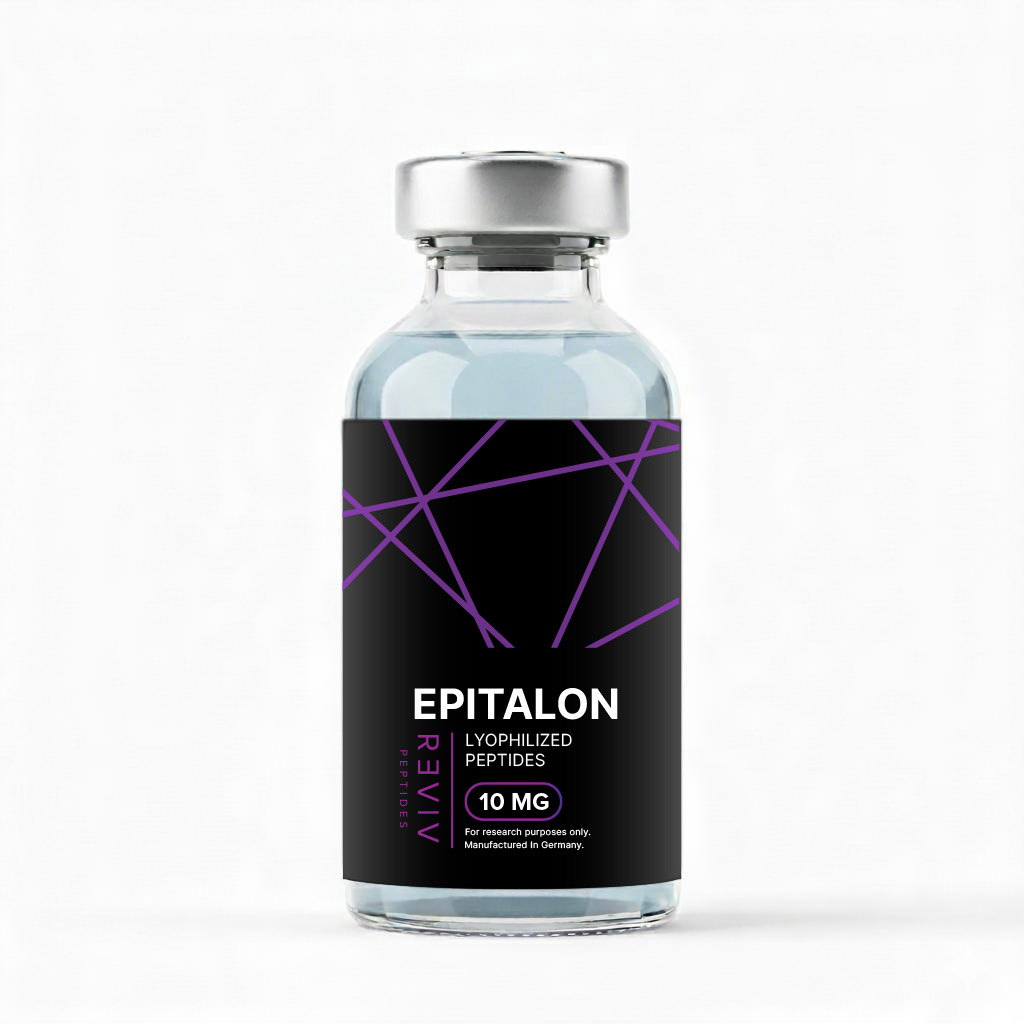
Reviv Peptides supplies research-grade Epitalon with a third-party COA and HPLC purity confirmation. View the Epitalon 10mg product page.
Epitalon belongs to a small club of longevity research peptides, and no two members work quite the same way. This one goes after telomerase and the pineal gland. GHK-Cu, the copper peptide, reaches much wider, rewiring thousands of genes and helping rebuild the matrix between cells. The mitochondrial peptides take yet another route entirely: MOTS-c flips on AMPK to support metabolism, Humanin blocks BAX to keep nerve cells alive, and SS-31 steadies cardiolipin to shield mitochondrial membranes. There’s no single winner here, because each one targets a different corner of aging. The case for Epitalon is narrow and specific, so reach for it when telomere or pineal biology is the question on the bench.
Yes, for the specific jobs it targets: turning on telomerase in human cell cultures, keeping telomeres longer, restoring pineal melatonin, and modest lifespan gains in rodents. The effects are slow and modest, and broad “anti-aging” claims overstate the published data.
Yes, in Canada and the United States as a research chemical sold for laboratory research only. Russia approves it as a finished pharmaceutical bioregulator, and it isn’t on the WADA banned list.
Through the same telomere-extending action, it lets skin cells divide more times, which can support collagen and elastin over a longer window. The skin effects are subtle and slow.
There’s little published support. A few rodent studies report more hair-follicle activity, but human evidence is basically missing. It isn’t a proven hair-growth treatment.
It turns on telomerase and extends telomeres in cultured human cells. Longer telomeres let cells divide more times, an effect linked to modest lifespan gains in rodent aging studies.
Key data point: in cultured normal human cells, the peptide reactivated telomerase and lengthened telomeres, then let those cells divide past the Hayflick limit, all without tipping them into cancer-like behavior.[1][2]
Epitalon is one of the most studied longevity peptides in the literature, with documented effects on telomerase, telomere length in human cells, pineal melatonin, and modest rodent lifespan gains. Russia approves the synthetic tetrapeptide as a bioregulator; Canada and the United States treat it as a research chemical for laboratory research only. The effect sizes are modest but repeatable, and it stays one of the cleanest examples of safely switching telomerase back on in normal cells. For anyone studying telomere biology, pineal function, or longevity, it’s a well-characterized tool peptide with three decades of work behind it.
Sources: [1] Telomerase activity and telomere elongation in human cells, PubMed. [2] Peptide overcomes the cell division limit, PubMed. [3] Effect on melatonin circadian rhythm in elderly people, PubMed. [4] Overview of Epitalon pineal tetrapeptide, PubMed. [5] Effect on aging markers, lifespan, and tumors in mice, PubMed. [6] Reference standards for synthetic peptide quality (HPLC + MS purity), PMC.

The Reviv Peptides Research Team is a collective of science writers and researchers dedicated to producing evidence-based, peer-reviewed-grade content about research peptides. Our work focuses on molecular mechanisms, receptor pharmacology, and preclinical data — including GLP-1/GIP/glucagon incretin biology, growth hormone axis peptides (GHRH analogs and ghrelin-receptor secretagogues), mitochondrial-derived peptides (MOTS-c, SS-31), tissue-repair peptides (BPC-157, TB-500, GHK-Cu), and nootropic peptides (Semax, Selank). All content is written in a strict preclinical/laboratory context; none of our editorial material is intended as medical advice. Every guide is reviewed for scientific accuracy against published peer-reviewed literature.
A plain-language guide to the Canadian legal framework around peptides and the supplier criteria researchers should actually verify.

A laboratory-style guide to reconstituting lyophilized peptides with bacteriostatic water, dosing math, syringe selection, and storage best practices.